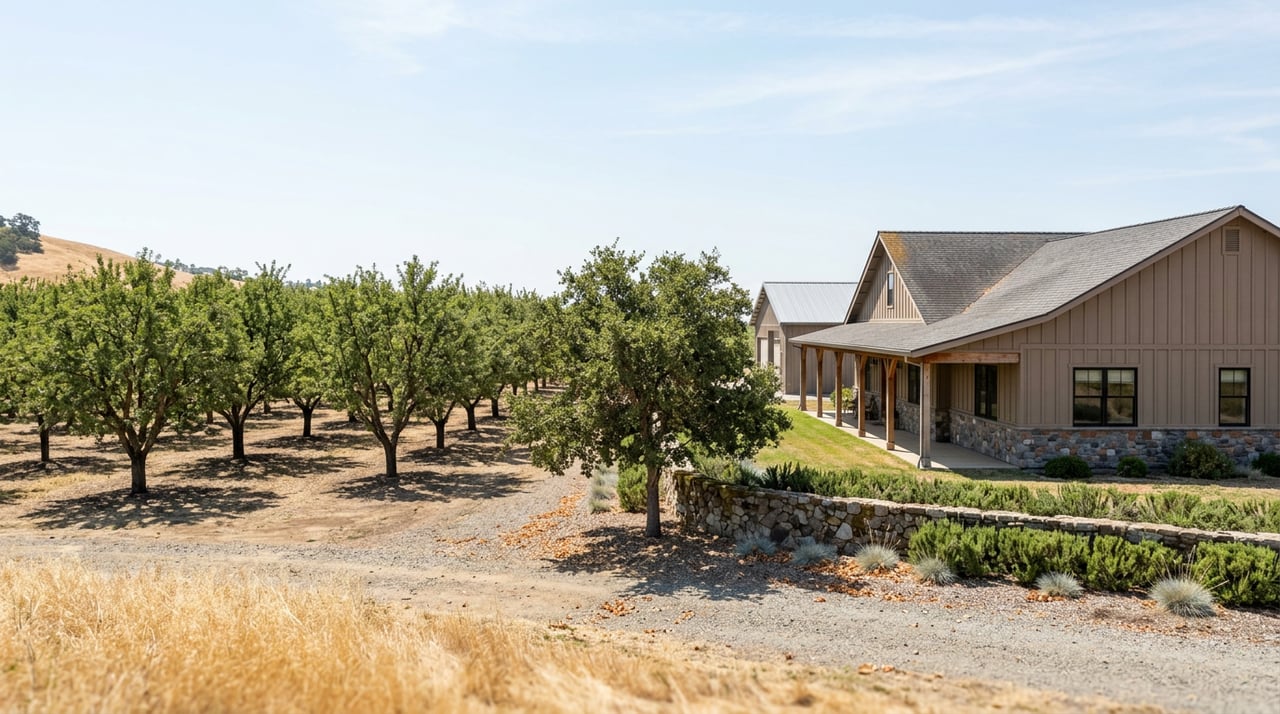
Why would two forty-acre parcels a few miles apart in eastern Fresno County price ten to twenty thousand dollars apart per acre, with the same soil, the same rainfall, and land that looks identical from the road?
The answer isn't crop mix, and it isn't acreage. It's a line on a water district map that most buyers never think to ask about until an appraisal comes back lower than expected.
California's farmland market has been sliding since 2023. Almond orchards that traded for $60,000 an acre a few years ago now sell for under $44,000, with most deals landing in the low to mid $30,000s, according to the most recent annual Trends report from the California chapter of the American Society of Farm Managers and Rural Appraisers, released in early 2025. One farm manager estimated the statewide pullback has erased roughly $17 billion in irrigated-land value. Higher interest rates and weaker commodity prices did most of the damage.
Fresno County land inside the Fresno Irrigation District didn't get that memo. Cropland there sold for as high as $36,000 an acre in the same reporting period, a move appraisers flagged as a rare upward outlier against a statewide trend that was going the other direction almost everywhere else.
The mechanism isn't the crop. It's the water contract behind the parcel.
Matt Pennebaker, a broker and accredited rural appraiser with Advanced Ag Realty & Appraisal in Reedley, put it plainly when describing why buyers keep gravitating toward the same handful of water districts even as the broader market cools:
"People are getting out of these less water secure areas and they're trying to get into FID. FID has limited ground. We usually have 20-acre and 40-acre parcels in those areas, so they're tightly held, hard to get into, and when they do come on the market, they still hold a good value."
That's a market behaving exactly the way a scarce, reliable input should behave. When something everyone needs is limited and hard to replace, price holds even while the surrounding category drops.
An earlier round of the same annual survey put numbers to the gap in a way that's easy to picture. In eastern Fresno County, land served only by private wells traded between $10,000 and $15,000 an acre, while comparable ground with both wells and Fresno Irrigation District delivery brought $16,000 to $32,000 an acre. Same region, same general soil type, and the difference came down entirely to whether the parcel could pull water from the district's canal system in a dry year.
A separate analysis from the UC Institute for Water Resources found the same pattern using a different dataset. Irrigation districts with reliable surface water access, what researchers labeled Tier 1, saw farmland values climb 30 percent between 2018 and 2023, from roughly $31,000 to $40,000 an acre. Tier 2 districts, dependent mainly on groundwater, stayed essentially flat near $24,000 an acre over the same stretch. By 2022 through 2024, almond transactions in Tier 1 districts averaged around $40,000 an acre against just over $20,000 an acre in Tier 2 districts. Two independent studies, two different years, the same conclusion: the water contract is doing more work than the crop.
Water access type | Reported per-acre range | Source period |
|---|---|---|
Wells only, eastern Fresno County | $10,000 to $15,000 | 2022 sales |
Wells plus FID delivery, eastern Fresno County | $16,000 to $32,000 | 2022 sales |
Tier 1 districts (surface water) statewide | $31,000 to $40,000 | 2018 to 2023 |
Tier 2 districts (groundwater only) statewide | roughly $24,000, flat | 2018 to 2023 |
FID cropland, statewide outlier sale | up to $36,000 | most recent Trends report, released early 2025 |
Why Fresno Irrigation District's water is more secure to begin with
The gap isn't an accident of recent policy. It traces back more than a century. Fresno Irrigation District was formed in 1920, but its water rights on the Kings River go back further, to the canal system built by Moses J. Church starting in the 1870s. Church, later remembered as the father of Fresno irrigation, developed the original Fresno Canal and helped establish agricultural colonies like the 4,000-acre Central California Colony, platted in 1875, that sold farmland alongside water rights from the start. Districts formed that early on a river with strong flows often hold senior appropriative rights, the kind that get honored first when supply gets tight. Districts that depend instead on federal contract deliveries through the Central Valley Project are further back in that line.
FID has kept building on that head start rather than coasting on it. The district serves more than 200,000 acres across Fresno and Clovis through nearly 700 miles of canals and pipeline, and it has spent recent years pairing that surface water with active groundwater recharge. FID's general manager set a goal in 2021 to acquire 420 acres for new recharge basins by 2023 and the district was ahead of that pace. In late June 2026, the district held a ribbon cutting for its Savory Basin, one of at least ten new basins designed to capture flood flows in wet years and bank them underground for the next drought. Board Chairman Ryan Jacobsen has described the approach as decades in the making, noting that most of the district's soils recharge well and that the practice of using both surface deliveries and groundwater banking together has been a habit, not a recent scramble.
That combination, senior river rights plus an active recharge program, is the actual asset a buyer is pricing when they pay a premium for land inside the district. It isn't sentiment. It's a functioning water system with more than a century of continuity behind it.
What this means if you're buying or selling ag land in Fresno County
If you're selling acreage anywhere near a district boundary, don't assume the county-wide headline about falling values applies to your specific parcel. Pull the assessor's parcel number and check which irrigation district actually claims it before setting an asking price. Land a half mile outside FID's boundary, dependent on wells alone, is playing in a different market than land just inside it, even if both parcels look the same in a drive-by.
If you're buying, the water district line matters more than the acreage total or the current planting. A younger orchard inside a secure district is a different investment than a mature orchard sitting on a groundwater-only supply, and the appraisal will eventually say so even if the listing price doesn't. It's also worth checking whether the parcel carries a Williamson Act contract, since that changes the property tax picture independently of water access and is a separate item to verify in title and disclosures before you write an offer.
This is also where financing and property strategy connect directly. Lenders evaluating rural and agricultural property look hard at water reliability when they underwrite a loan, because it drives both the land's value and its long-term productivity. Understanding a parcel's water district status before you make an offer, rather than discovering it during underwriting, saves time and negotiating room on both sides of the transaction.
A few questions that come up
How do I find out which water district my parcel is actually in? Fresno Irrigation District publishes boundary maps on its own site, and the county assessor's parcel search will show the assessment area tied to a specific APN. Checking both before making an offer or setting a list price avoids surprises later in escrow.
Does being inside FID guarantee land will keep gaining value? No. The district's advantage comes from a specific combination of senior water rights and active recharge investment, not a guarantee. Commodity prices, interest rates, and crop-specific demand still move values within the district. The point is that water access changes the starting line, not that it removes market risk entirely.
Is land outside FID's boundary a bad investment? Not necessarily. Groundwater-only parcels can still work well depending on well depth, basin conditions, and how the buyer intends to use the land. The key is pricing the water risk accurately rather than assuming county or state averages apply evenly across every parcel.
Fresno County's farmland market isn't one market right now. It's at least two, split along a boundary line most buyers never look up until it's already reflected in the appraisal. If you're weighing a rural purchase or sale anywhere in the Central Valley and want to talk through what a specific parcel's water access actually means for value and financing, Sean Harper is glad to walk through it with you. Let's Connect.
